The Hidden Danger of select on a Shared ioredis Connnection
This post documents what went wrong in using ioredis
A subtle but painful bug recently cost me a significant amount of debugging time. This post documents what went wrong, what the root cause was, and how to avoid the same trap.
The Setup#
I have a Node.js application using a single persistent ioredis client shared across API endpoints. Two of those endpoints read from different Redis databases:
/endpoint0reads from db 0 using a straightforwardGET:
const res = await client.get(someKey)/endpoint2reads from db 2 using a pipeline withSELECT:
const [res1, res2] = await client.multi().select(2).hget(hash, key).exec()/endpoint0 was added well after /endpoint2 was already in production. Shortly
after it was introduced, an intermittent failure started appearing — calls to
/endpoint0 would begin returning incorrect results some time after a fresh
deployment, and a redeployment would temporarily resolve it.
The Investigation#
The bug manifested across all environments — dev, UAT, and production — which ruled out environment-specific configuration issues. I checked dependency declaration order, environment variable handling, and the deployment pipeline itself. None of those investigations turned up anything.
The breakthrough came when I inspected the output of CLIENT LIST directly on
the Redis server:
id=501766576 addr=192.168.1.57:61819 fd=36 name= age=701 idle=623 flags=N db=0 sub=0 psub=0 multi=-1 qbuf=0 qbuf-free=0 obl=0 oll=0 omem=0 events=r cmd=hget

id=501692280 addr=192.168.1.57:24319 fd=10 name= age=3619 idle=4 flags=N db=2 sub=0 psub=0 multi=-1 qbuf=0 qbuf-free=0 obl=0 oll=0 omem=0 events=r cmd=getThe db=2 field on the second connection immediately stood out. A connection
that should have been operating on db 0 was sitting on db 2 — which pointed
directly at the select call in /endpoint2.
The Root Cause#
SELECT in Redis — and by extension client.select() or client.multi().select()
in ioredis — is a stateful, connection-level operation. It does not scope to
a single command or pipeline; it changes the active database for that connection
and the change persists until another SELECT is issued.
When a shared connection is used, any call to SELECT affects every subsequent
command on that connection, regardless of which endpoint or function issued them.
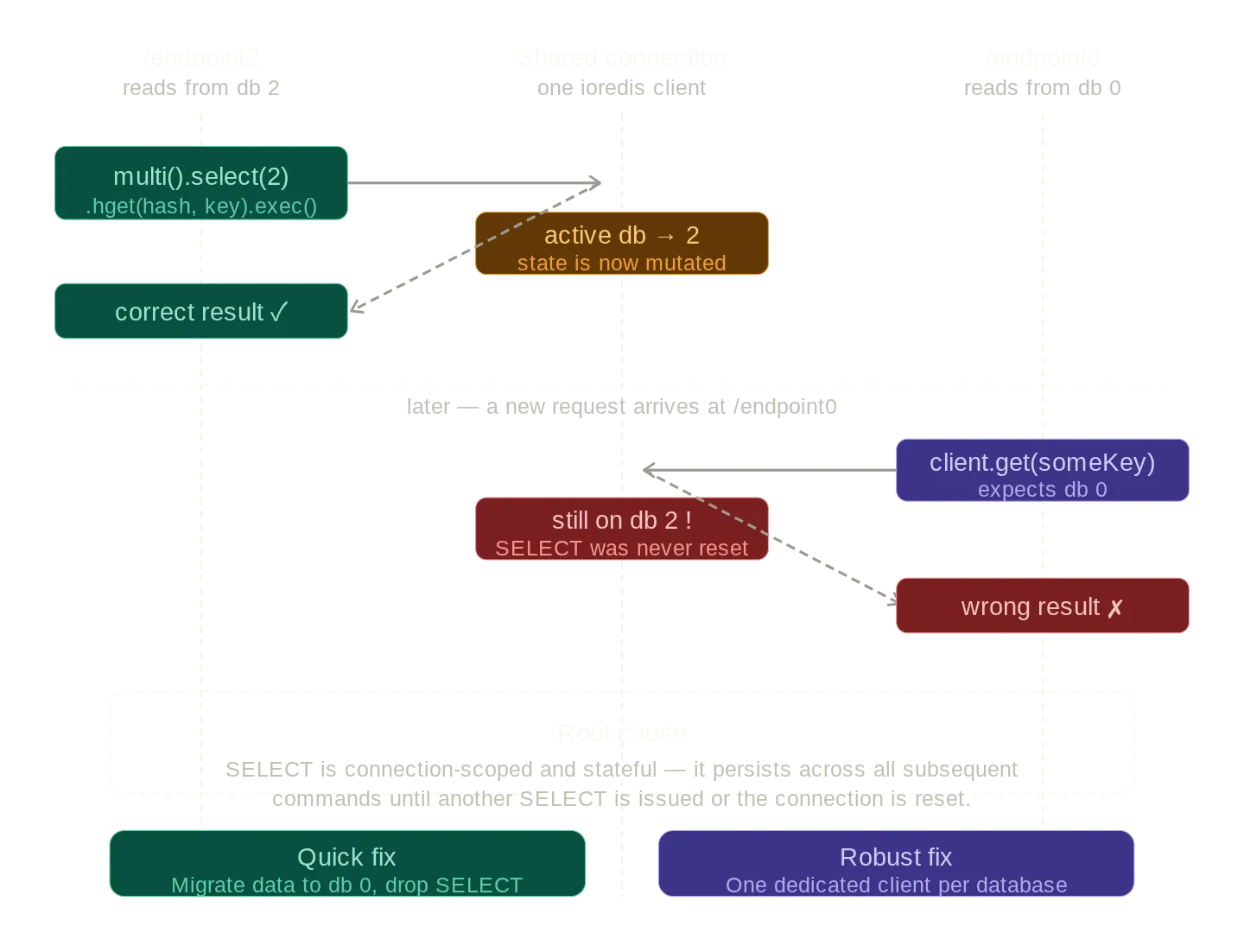
In this case, once /endpoint2 ran and switched the connection to db 2, any
subsequent call from /endpoint0 was unknowingly querying db 2 instead of db 0. Refer to this diagram for a better understanding of the problem:
The Fix#
In this specific case, the simplest resolution was to migrate the data for
/endpoint2 into db 0, eliminating the need for SELECT entirely:
const res = await client.hget(hash, key)The more robust and general solution — especially in applications where multiple
databases are genuinely required — is to create a dedicated ioredis client per
database. Calling SELECT at runtime on a shared connection is a latent bug
waiting to surface, and it will do so in ways that are difficult to reproduce and
trace.
Takeaway#
If you are using ioredis with multiple Redis databases in a shared-connection
setup, avoid SELECT at runtime. Provision one client per database instead, and
make the database assignment explicit at initialization. It is a small upfront
cost that eliminates an entire class of hard-to-debug, timing-dependent failures.